
The Commissioner for Protection of Rights and Legitimate Interests of Entrepreneurs under the President of the Republic of Uzbekistan
News
Dec. 9, 2025
Financing and subsidy plans for the agricultural sector reviewed
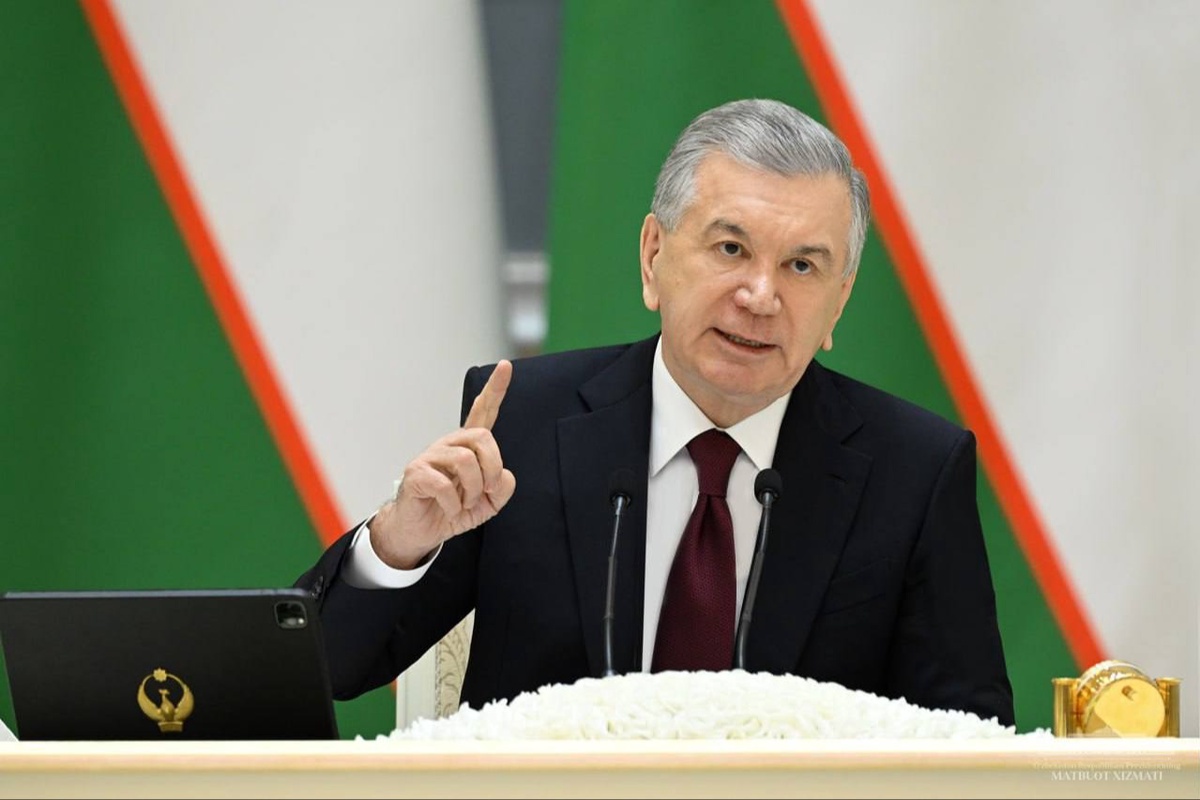
President Shavkat Mirziyoyev reviewed a presentation on the effective organization of financing for cotton and grain cultivation, as well as a new subsidy system for the agriculture complex.
The
presentation began with an overview of the funds allocated to the sector this
year and their effectiveness.
It was
noted that 29 trillion soums were allocated for financing cotton and grain
cultivation, purchasing agricultural machinery, and implementing water-saving
technologies. Furthermore, 2,35 trillion soums in subsidies were directed to
the sector.
Allocating
subsidies equivalent to 10 percent of the cotton value to 3,430 farms and
clusters enabled them to cultivate cotton on 151 thousand hectares using their
own funds, resulting in savings of 1,9 trillion soums.
Moreover,
farmers who fully repaid their loans for cotton cultivation this year were
offered a reimbursement of 4 percentage points on their payments, which led to
9,002 farmers prepaying preferential loans worth 2,5 trillion soums.
A total of
34,2 trillion soums is planned for the cotton and grain harvest, subsidies and
other expenses next year. Additionally, there are plans to attract an extra
$200 million to purchase 800 cotton harvesting machines. In this regard, new
support mechanisms were reviewed.
Particularly,
it was proposed to allocate an additional 5 trillion soums in 2026 for
agrotechnical measures, including expenses for wrap and pipes. It was noted
that if farmers use up to 50 percent of their crop cultivation credit limit and
receive a subsidy of 5 percent of the value of the sold cotton, the number of
farmers growing crops with their own funds and partial loans will reach 4-4,5
thousand with savings amounting to 2,5-3 trillion soums.
Currently,
when providing loans to farmers, the same interest rate is applied to both
financially stable farms and those with poor payment discipline. In this
context, to implement a “discipline for affordable credit” model, it is
proposed to offer loans to farms with an “A” credit rating at a 2 percent
reduced rate and to those in the “B” category at a 1 percent reduction, which
will ease the credit burden for farmers with good payment discipline.
Moreover,
it was proposed to provide a 10 percent subsidy to farmers who grow wheat at
the expense of their own funds.
As the Head
of our state noted, supporting farmers, strengthening their trust and economic
interest is a key foundation for the development of agriculture, and therefore
the support mechanisms in the sphere will be consistently expanded.
In
accordance with the Decree of the President of Uzbekistan “On measures for the
fundamental improvement of the state support system for the agricultural
sector” dated November 22 this year, the Agricultural Payments Agency has been
established under the Ministry of Agriculture to improve the mechanisms of
state support for the sector.
During the
presentation, the issue of the organization of the tasks assigned to the agency
was reviewed.
Currently,
there are 52 types of subsidies in agriculture. Under the new system, these
processes will be fundamentally simplified: the human factor and bureaucracy
will be significantly reduced, application reviews will be fully digitized, and
all procedures will be conducted through the “Agroportal”.
Therefore,
the information systems of more than 10 ministries and agencies will be
integrated into the “Agrosubsidy” information system.
In
particular, subsidies worth 1,3 trillion soums allocated for 2026 will be
provided proactively by government agencies without requiring applicant
involvement, the remainder will be disbursed through a simplified procedure by
eliminating certain stages of approval, issuance of opinions and document
processing. As a result, the time required to grant subsidies will be
significantly reduced.
The Head of
state gave specific instructions to further improve financing mechanisms,
ensure subsidies are targeted and delivered promptly, digitalize all processes,
and create favorable conditions for farmers.
Shavkat Mirziyoyev
President of the Republic of Uzbekistan"The entrepreneurial movement in Uzbekistan has become an irreversible force. The richer our entrepreneurs are, the more prosperous our people will live, the more powerful our state will be. The success of an entrepreneur is the success of our entire nation."
